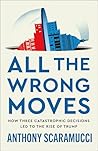
 All the Wrong Moves: How Three Catastrophic Decisions Led to the Rise of Trump by Anthony Scaramucci
My rating: 4 of 5 stars
Looking back on buying into the Trump idea, Scaramucci finds three pivotal trends pre-Trump that made his rise possible:
1. Privileging China. Clinton supports the WTO in giving China special privileges in trade, hurting American workers deeply, quickly, and permanently.
2. Waging War Without Taxes. George W. Bush invades Iraq while simultaneously cutting taxes, thereby shifting the cost of a misguided, multitrillion-dollar effort to alter the entire Middle East to ordinary Americans, while removing any buffer between them and ruination.
3. Bailing Out Wall Street. Obama bails out banks and Wall Street, which were failing largely thanks to Clinton's and Bush's finance policies, while ordinary Americans by the millions lose homes and livelihoods.
At least a couple of times her refers to a historical "Crackup" without explanation:
...a celebration of the fiftieth anniversary of the IMF and the World Bank was loudly interrupted by protests. By June 1999, the movement's organizational power had grown. That month, cities around the world took part in the Carnival Against Capital, and in the Eugene, Oregon, event that day, anarchists clashed with police, with temporary success, pushing them out of a park.
Which I take to be the mixture of anarchism and radical environmentalism, punk rock and old-hippiedom opening the door to populism. He uses the term to describe the social upheavals of the late 1960s and early 1970s, a period when the established order began to break down:
• The Fragmenting of Consensus: The sudden shattering of traditional social norms, trust in institutions, and postwar political stability.
• The Countercultural Wave: The explosion of radical anti-establishment politics, hippie communes, anti-war protests, and psychedelic culture that shook America.
• The Political Realignment: Events like the televised clashes between police and anti-war protesters at the 1968 Chicago Democratic National Convention. Andersen identifies these as early milestones of a "crackup" that permanently fractured the American left and gave rise to a fierce conservative cultural backlash.
By linking the 1999 anti-globalization protests back to "the Crackup that began in the '60s," the author is arguing that the Carnival Against Capital, for example, wasn't entirely a modern phenomenon. Instead, its mix of radical anarchy and alternative lifestyle was a direct echo of that original 1960s cultural collapse.
I don't know if I am entirely convinced of this three root cause. I do believe a manifold of historical events gave the U.S. an authoritarian president and subservient other branches of government. I am more behind his prescriptive cures:
1. Stronger rules against monopoly.
2. Taxation overhaul.
3. Tariff correctives.
4. Election funding reform.
5. Fight partisan gerrymandering.
6. Strengthen investigations to be outside of executive branch control
A small nitpick: I loath the Garamond font used here and popularly. I especially don't like that capital "I" and numeral 1 have the same symbol.
View all my reviews




No comments:
Post a Comment