Wednesday, February 17, 2016

Review: Polyhedra Primer

Polyhedra Primer Polyhedra Primer by Peter Jon Pearce
My rating: 2 of 5 stars

Author Peter Pearce is an American product designer, author, and inventor. He was an assistant to Buckminster Fuller and like his mentor, Pearce advocates for inspiration from basic 2- and 3-dimensional polytopes. This primer is a basic catalog of images and descriptions with only rudimentary mathematics such as a statement of Euler’s formula relating the number of vertices, edges and faces of a convex polyhedron. First published in 1978, this is a visual gallery of inspiration for designers, architects, artists, and other creators...


[Look for my entire review at MAA Reviews]

View all my reviews

Review: Functional approach to precalculus

Functional approach to precalculus Functional approach to precalculus by Mustafa A. Munem
My rating: 4 of 5 stars

This text came out the year I was born as a textbook for a community college in a county adjacent to the one I teach at 45 years later. This was a fully digested of the New Mathematics or New Math brief, dramatic change in the way mathematics was taught in American grade schools during the 1960s. While the phrase is often used now to describe this change as a short-lived pedagogical fad which quickly became highly discredited, the set of teaching practices introduced in the U.S. shortly after the Sputnik crisis in order to boost science education and mathematical skill in the population, introduced topics seen here including modular arithmetic, algebraic inequalities, and abstract algebra. These topics have been greatly de-emphasized or eliminated in US elementary schools and high schools curricula since then while built upon outside of the US. Consequently, a typical US math student is a good academic year behind foreign students who also tend to school for longer during the year. The rules of sets would later prove to be very valuable with the onset of databases and other formations of data that were emerging in society. I find it is the area my incoming students are weakest at when I meet them in their final semester before calculus where the readers of this text were grappling with the idea of a set algebraically closed under an operation. This is something we cannot approach at the level of a first-year college student, any longer. This allows such concepts as the circle as a set of equidistant points from a center as well as proofs and theorems – all notions current students are allergic to. I see the readers of this text could handle mathematical induction, now an optional and often foregone topic, as well as periodic function, basic trigonometry to inverses of the sine and cosine as well as vectors and polar coordinates. Now, these topics, a good engineering foundation, have their own semester.

As this book was falling apart, I disassembled it into two piles: on the left material still taught at my CC at that level and thus of use to me as classroom capsule, and on the right the hefty stack of material now behind the reach of my students:

 photo temp_zps2e2cpzy0.jpg

View all my reviews

Tuesday, February 16, 2016

Review: An American Childhood

An American Childhood An American Childhood by Annie Dillard
My rating: 4 of 5 stars

Wow! What a delight this memoir of growing up as a precocious, perspicacious young lady. The book is dream-like in its definite and affected retelling of moments and memories in short chapter vignettes. This includes family life with a father yearning for the raucous life of New Orleans and the tranquility of river travel and a cynical, wry mother that reminds me of the one in Once I was a Teenager: Growing up in the 50s and 60s in Australia and beyond. Annie recalls being snowed in for the Great Appalachian Storm of November 1950, discovering amateur microscopy, ominous Cold War fears, and more.

She has a charming, descriptive style. I never cared why buckeyes were named 'til I read here "Buckeyes were wealth. A ripe buckeye husk splits. It reveals the shining brown sphere inside only partially, as an eyelid only partially discloses an eye's sphere. The nut so revealed looks like the clam brown eye of a buck, apparently. It was odd to imagine the settlers who named it having seen more male deer's eyes in the forest than nuts on a lawn."

However, her real excitement and depth of feeling comes across in the lengthy two-thirds meet of the book given over as a paean to reading itself. It praises individual titles, whole subject areas, the Homewood branch of Pittsburgh's Carnegie Library: "I began reading books, reading to delirium. I began by vanishing from the known word into the passive abyss of reading, but soon found myself engaged with surprising vigor because of thing in the books, or even the things surrounding the books, roused me from my stupor." Never did an abyss sound so warm and inviting! I put up there on par with Thoreau's "Reading" chapter in Walden.

View all my reviews

Review: An American Childhood

An American Childhood An American Childhood by Annie Dillard
My rating: 4 of 5 stars

Wow! What a delight this memoir of growing up as a precocious, perspicacious young lady. The book is dream-like in its definite and affected retelling of moments and memories in short chapter vignettes. This includes family life with a father yearning for the raucous life of New Orleans and the tranquility of river travel and a cynical, wry mother that reminds me of the one in Once I was a Teenager: Growing up in the 50s and 60s in Australia and beyond. Annie recalls being snowed in for Great Appalachian Storm of November 1950


TBC

View all my reviews

Sunday, February 14, 2016

Review: Game Theory: A Nontechnical Introduction

Game Theory: A Nontechnical Introduction Game Theory: A Nontechnical Introduction by Morton D. Davis
My rating: 4 of 5 stars

When I read that Douglas R. Hofstadter called this work a “lucid and penetrating development of game theory that will appeal to the intuition,” I knew I wanted to read this overview of "the study of mathematical models of conflict and cooperation between intelligent rational decision-makers”, as Roger B. Myerson defined game theory. Published originally in 1970, the reprinted classic looks back to the foundations of game theory laid by John von Neumann. Von Neumann’s basic minimax theorem, proved in 1928, is core to Chapter 2 on two-person, zero-sum games. Being a nontechnical introduction, proof and a good detail of mathematical mechanics are foregone to get a high-level view of the properties of this technique as an applied art and its many applications to social, economic, and political problems...

[Look for my entire review up at MAA Reviews]


View all my reviews

Thursday, February 11, 2016

Review: Guns, Germs and Steel: The Fates of Human Societies

Guns, Germs and Steel: The Fates of Human Societies Guns, Germs and Steel: The Fates of Human Societies by Jared Diamond
My rating: 4 of 5 stars

This is an important, perceptive work that aims to fight against racist interpretations that the march to ward progress of various peoples is biological, not based on their environment, opportunity, and access to resources. (That is really something we still need to fight?) Diamond does well making his point with continental topography (longitudinal axis of Eurasian versus the longitudinal one of the Western Hemisphere, e.g.), and climes (it's easier to bring crops marching on the same latitude than into other climate zones). This 13,000 year history is bolstered by calibrated C14 dating, which he does well to stress.

His surveys of botany, animal domestications, linguistics, etc. are high-level and thus easily understood in this populist yet enlightening work. This updated version has a chapter dedicated to Japan. There apparently was a real need to approach the thorny issue of Korean or Japanese primacy on the island chain, which Diamond does delicately even though this really seems to stray from the point. Why not instead bring in more recent science, such as evidence for pre-Clovis Polynesian colonization of South America?

View all my reviews

Wednesday, February 10, 2016

Review: The Lost City of Z: A Tale of Deadly Obsession in the Amazon

The Lost City of Z: A Tale of Deadly Obsession in the Amazon The Lost City of Z: A Tale of Deadly Obsession in the Amazon by David Grann
My rating: 4 of 5 stars

I really enjoyed this fast-paced adventure reportage where the author that wowed me with The Devil & Sherlock Holmes: Tales of Murder, Madness & Obsession pulled me into the zeal for Z as he fell prey as had hundreds others to tracking Percy Fawcett into Xingu and the remotest Amazon with its harried and violent natives. Fawcett's life story, as is known, with that of his steadfast wife and sons is interwoven with Grann's sleuthing from archives to the Amazon and the tales of cranks and explorers alike. The real tale that emerges is interesting but not as intriguing as the archeological evidence for how true, if unobtainable for Fawcett, Z may have been. Now I must read The Ecology of Power: Culture, Place and Personhood in the Southern Amazon, Ad 1000 2000.

View all my reviews

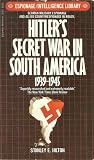
Review: Hitler's Secret War in South America

Hitler's Secret War in South America by Stanley E. Hilton My rating: 3 of 5 stars View...