Sunday, September 14, 2014

Review: Stress Test: Reflections on Financial Crises


Stress Test: Reflections on Financial Crises
Stress Test: Reflections on Financial Crises by Timothy F. Geithner

My rating: 3 of 5 stars


I really enjoyed this book from Geithner. I found his honest, self-deprecating and reflective manner refreshing in books I have read on our many years of financial crises. Geithner had a ringside seat to many such crises in his years in public service: Asia, Japan, Mexico, etc. before becoming embroiled in the birthing of TARP onto a ringside seat for the throes of the PIIGS. I feel about done with book son this subject: the complexity our financial system and the political heave-hos are starting to bore me.

My reading has summed up this way for me: The American financial crises spanned multiple presidencies of both parties and the system, basically, worked avoiding something like the Great Depression despite corruptive greed and senseless risk taking.

A minor part in this book is candid glances into the Obama Whitehouse, like that Obama like Five Guys but Geithner who has been in a bubble of pulbic service doesn't know for that burger joint, or eve the honey badger meme.


View all my reviews

Saturday, September 13, 2014

Review: Storming to Power


Storming to Power
Storming to Power by Time-Life Books

My rating: 3 of 5 stars


While I am rating this the same, I did not enjoy it as much as the first in the series: [b:The New Order|709662|The New Order|Time-Life Books|https://s.gr-assets.com/assets/nophoto/book/50x75-6121bf4c1f669098041843ec9650ca19.png|695930]. However, I see it as possibly the necessary, less interesting middle act sandwiched between tension-building exposition and dramatic conclusion. The story is of Hitler's methodical, purposeful accumulation of political power covers nearly a decade of rallies and manoeuvring. In this, we learn how he was a political chameleon ("no you can't make highways"/"yes, we do the autobahn and it was always my idea", etc.) and betrayed friends with the same ease with which he crushed enemies. Up next, I will find out how this story ends in [b:The SS|860082|The SS (Third Reich Series)|Time-Life Books|https://d.gr-assets.com/books/1203726521s/860082.jpg|845522].

Overall, this series is proving to be better than expected.


View all my reviews

Wednesday, September 10, 2014

Review: Fueling Innovation and Discovery


Fueling Innovation and Discovery
Fueling Innovation and Discovery by Dana Mackenzie, National Research Council

My rating: 3 of 5 stars


The angle of showing the contribution of mathematics in our lives here is at a very high level and touches on math-based IPOs (Google, etc.), imaging for medical science, bioinformatics, etc. The effect is a call for eager minds to choose math as a rewarding career.


View all my reviews

Monday, September 8, 2014

Review: The Letters of Machiavelli: Newly Edited and Translated


The Letters of Machiavelli: Newly Edited and Translated
The Letters of Machiavelli: Newly Edited and Translated by Allan Gilbert

My rating: 2 of 5 stars


This is a fascinating book, if only for seeing into the thinking and life of a 16th Century luminary of Florence at a time when Popes commanded armies (with surprising fallibility) and letters had to be hand delivered by friendly messengers (with unsurprising lack of reliability).

Some things I didn't like about the presentation: the letter-specific notes collected in one, large introduction when it would be better to intersperse them so that they were strategically places alongside relevant letters. Also, maybe not every letter to Machiavelli would have been helpful, but I am sure a few to several would have really helped. As a minor point, relying Machiavelli's first name should have stopped after any risk of confusion with family members was past.

I was surprised how crude and chummy Machiavelli was in letters to an ambassador (not about him personally, but how this is indicative about how base and common such communications could have been then). I was also surprised to learn how meteoric and inexplicable was his rise to government, but the vagaries of fortune once tied to the De Medici family made tragic sense. I was also surprised how involved and opinionated he was in military affairs.


View all my reviews

Saturday, August 30, 2014

Review: A Graphical Approach to College Algebra


A Graphical Approach to College Algebra
A Graphical Approach to College Algebra by John Hornsby

My rating: 3 of 5 stars


Now that my OCC campus has retired this text, I can reflect back on teaching through it over a few years. I basically found this passable with notable awkward parts. For instance, Square Root Property is not admitted until half way through the text when it should be at beginning. Also, breaking up core material on systems of equations between chapters and appendices is schizophrenic.

Things I like include a focus on basic functions and transformations, basically the "graphical approach" in the title. This makes it convenient to highlight key connections between functions, their graphs, and set basis.


View all my reviews

Wednesday, August 27, 2014

Review: Cony-Catchers and Bawdy Baskets: An Anthology of Elizabethan Low Life


Cony-Catchers and Bawdy Baskets: An Anthology of Elizabethan Low Life
Cony-Catchers and Bawdy Baskets: An Anthology of Elizabethan Low Life by Gamini Salgado

My rating: 4 of 5 stars


This was an incredible and different book; a compendium of literature born of and documenting the organized Elizabethan criminal class. I was intrigued by the varied taxonomy of "cony-catching" cons and crooks from common pickpockets and prostitutes to more exotic varieties like those hook things with poles through windows, the "jarkman" vagabond counterfeiter of documents (as licenses, passes, certificates), and illegal coal crews. The horse thieves ("priggers of prancers" as in the colorful slang terminology, glossary on 146) played a role like long-term car thieves, including obscuring marks then as someone would w/VINs now. It seems whenever I read of an epoch's crime body, there is likely an element of disaffected veterans that were not successfully re-integrated into society. Among the ways that shows here is the heavies, the "rufflers".

Then there is "co" (pp. 66, 138), apparently a boy, a rogue, or both. Why can't this 2-letter word be legal in Scrabble and Words With Friends?!

It amazes me how much social engineering, a hallmark of spearphishing and more today, was so important to these crooks. Also, the editors' decisions between footnotes and endnotes is schizophrenic.


View all my reviews

Review: The Poison King: The Life And Legend Of Mithradates, Rome's Deadliest Enemy


The Poison King: The Life And Legend Of Mithradates, Rome's Deadliest Enemy
The Poison King: The Life And Legend Of Mithradates, Rome's Deadliest Enemy by Adrienne Mayor

My rating: 4 of 5 stars


An amazing story of a poison-obsessed resister to Roman imperial domination. With Hannibal (who can be senses, off stage) and Jugurtha, he completes the trinity of scourges of The Empire. The scholarship and archaeology that supports this biography is impressive and adds to this work which is very readable and not dry and textbook-like.

The epilogue speculations on Mithradates cheating death and then his final wife Hypsicratea persisting in secret posing as a male historian strikes me as fanciful and detracts from the more sober tone of the rest of the book.


View all my reviews

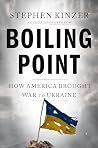
Review: Boiling Point: How America Brought War to Ukraine

Boiling Point: How America Brought War to Ukraine by Stephen Kinzer My rating: 4 of 5 stars ...