Thursday, April 7, 2016

Review: America's Bank: The Epic Struggle to Create the Federal Reserve

America's Bank: The Epic Struggle to Create the Federal Reserve America's Bank: The Epic Struggle to Create the Federal Reserve by Roger Lowenstein
My rating: 4 of 5 stars

This bit of political and financial history was more interesting and engaging than I expected. I had not known or forgotten that we are in the third and this time expectedly permanent central bank system here in the U.S. The First Bank of the United States, famously pushed for by Alexander Hamilton, the Secretary of the Treasury, lasted 1791–1811and was a present absence in the need to finance the War of 1812. The Second Bank of the United States (1816–1836) which James Madison signed the charter of, was a reaction to runaway inflation that had plagued the country during the five-year interim between national banks. Populist Andrew Jackson, who became president in 1828, denounced the bank as an engine of corruption. His destruction of the bank was a major political issue in the 1830s and shaped the Second Party System, as Democrats in the states opposed banks and Whigs supported them. Most of the book is about the 1907 - 1913 creation of the Federal Reserve System we now have. This includes the cabalistic genesis on Jekyll Island, GA to the The United States presidential election of 1912 and its rare four-way contest between incumbent President William Howard Taft (renominated by the Republican Party with the support of its conservative wing), former President Theodore Roosevelt and his own Progressive Party (nicknamed the "Bull Moose Party"), Democrat Woodrow Wilson finally nominated on the 46th ballot of a contentious convention thanks to the support of William Jennings Bryan, and Eugene V. Debs running for a fourth time as the nominee of the Socialist Party of America.

View all my reviews

Sunday, April 3, 2016

Review: Packing for Mars: The Curious Science of Life in the Void

Packing for Mars: The Curious Science of Life in the Void Packing for Mars: The Curious Science of Life in the Void by Mary Roach
My rating: 4 of 5 stars

Mary Roach's book here seems to combine the charms and idiosyncrasies of all here titles I have read: a zealous if fruitless search for sex in space (Bonk), what death from depressurization would really be like (Stiff: The Curious Lives of Human Cadavers) and a lengthy examination of icky food and resultant egesta (poo and pee) in the rockets (Gulp). I had been kinda over book-length discourses on space discoveries that haven't happened (The Eerie Silence: Renewing Our Search for Alien Intelligence, Confessions of an Alien Hunter: A Scientist's Search for Extraterrestrial Intelligence) and put off reading this, since NASA has not even scheduled a date to send men to mars. However, there is much more to this book, and the Mars angle is really a footnote. This is more about the history of technological development, mainly by the U.S. and Russia, to put humans in space, allow them to work there, and bring them back.

View all my reviews

Review: Knots, Molecules, and the Universe: An Introduction to Topology

Knots, Molecules, and the Universe: An Introduction to Topology Knots, Molecules, and the Universe: An Introduction to Topology by Erica Flapan
My rating: 0 of 5 stars

...This book introduces the elementary mathematics of topology with applications to chemistry and cosmology. Basically self-contained, it does not assume or require any mathematical background beyond the most basic algebra and set theory concepts and notation. Clearly meant to be fun, this can be an enjoyable read for the interested and nontechnical, or used as an undergraduate textbook. There are some ambitious undertakings by the authors, considering the audience, as the second chapter “Visualizing Four Dimensions” and the exploration of the Klein Bottle later in “Part 1: Universes”. Sticking with the material, the reader will have a good understanding of orientability, manifolds, Euler characteristic, and the genus of a surface. Keeping with the theme of assuming no real prior mathematical sophistication on the reader, proving the sidedness of a non-orientable 3-manifold is patiently walked through beginning with defining “if and only if”. This Part concludes with a thorough and enlightening dive info Euclid’s Axioms, since throughout non-Euclidean surfaces must be confronted...

[Look for my entire review at MAA Reviews]


View all my reviews

Saturday, April 2, 2016

Review: Ann-Margret: My Story

Ann-Margret: My Story Ann-Margret: My Story by Ann Margret
My rating: 3 of 5 stars

I really don't know for Ann-Margret of the big and small screens, but was attracted to this work due to my affection for the album "The Cowboy & the Lady", which she did with Lee Hazlewood. That opus only gets on sentences, and Lee isn't mentioned, although her disco album gets a whole paragraph! For the music fan, there is a whole chapter on working on Tommy, and the resulting friendship with Tina Turner. Most of the book is about growing up in Sweden, her career and marriage to Roger Smith, recovering from a tragic fall, and beating alcoholism and pill-popping. A quick, easy read of a vivacious woman with a rich life.

View all my reviews

Review: Walden Two

Walden Two Walden Two by B.F. Skinner
My rating: 4 of 5 stars

The operant conditioning chamber (also known as the Skinner box) created by B. F. Skinner would be enough to assure fame for the American psychologist, behaviorist, author, inventor, and social philosopher. This renaissance man is also a novelist. Having recently read Walden, I decided to take on this “controversial novel”. Technocrats of an apparently unexciting alternative 40s American decide on a lark to visit a self-sustaining commune, Walden Two. The productivity and happiness of citizens in this community is far greater than in the outside world because the residents practice scientific social planning and use operant conditioning in raising their children. Walden Two, like Henry David Thoreau, champions a lifestyle that does not support war or foster competition and social strife. It encourages a lifestyle of minimal consumption, rich social relationships, personal happiness, satisfying work and leisure. Unlike thorough, the community is not about one man’s solitude or a rejection of modern technology. Quite the opposite. (In 1967, Kat Kinkade founded the Twin Oaks Community, using Walden Two as a blueprint. The community still exists and continues to use the Planner-Manager system and other aspects described in Skinner's book.) Rather than "Walden Two", I think this book would be better named "The Republic Two", since the scale and approach has more to do with The Republic. As Will Durant says in The Story of Philosophy, "...policies should be administered by officials specifically prepared for the purpose, than by men who stumble out of commerce or manufacturing into political office without any training in the arts of is statesmanship." Skinner's Planner-Managers are more akin to the Philosopher-King guardians of Plato than Thoreau's self-sufficient loner.

The visiting group seems split in their opinions and a friendly fascism of the founder seems darker in this outburst on refuting the value of historical context:

"Are you saying that you gain no perspective-I mean, no detached
opinion-from a sense of history?"

"I mean that and more. Nothing confuses our evaluation of the present more than a sense of history-unless it's a sense of destiny. Your Hitlers are the men who use history to real advantage. It's exactly what they need. It obfuscates every attempt to get a clear appreciation of the present.

"Race, family, ancestor worship-these are the handmaidens of history, and we should have learned to beware of them by now. What we give our young people in Walden Two is a grasp of the current forces which a culture must deal with. None of your myths, none of your heroes-no history, no destiny-simply the Now! The present is the thing. It's the only thing we can deal
with, anyway, in a scientific way. But we've got a long way from the dictator.


Some parts of the founder’s philosophy seem calculated to offend some, such as finding autocratic powers in turning the other cheek:

"No, accident. Jesus discovered one principle because it had immediate consequences, and he got another thrown in for good measure.”

I began to see light.

"You mean the principle of love your enemies'?'' I
said.

"Exactly! To 'do good to those who despitefully use you' has two unrelated consequences. You gain the peace of mind we talked about the other day. Let the stronger man push you around-at least you avoid the torture of your own rage. That's the immediate consequence. What an astonishing discovery it must have been to find that in the long run you could control the stronger man in the same way!"


There is a hopefully benevolent paternalism here,

"The question is: Can men live in freedom and peace? And the answer is: Yes, if we can build a social structure which will satisfy the needs of everyone and in which everyone will want to observe the supporting code. But so far this has 'been achieved only in Walden Two. Your ruthless accusations to the contrary, Mr. Castle, this is the freest place on earth. And it is free precisely because we make no use of force or the threat of force. Every bit of our research, from the nursery through the psychological management of our adult membership, is directed toward that end-to exploit every alternative to forcible control. By skillful planning, by a wise choice of techniques we increase the feeling of freedom.

"It's not planning which infringes upon freedom, but planning which uses force. A sense of freedom was practically unknown in the planned society of Nazi Germany, because the planners made a fantastic use of force and the threat of force.

"No, Mr. Castle, when a science of behavior has once been achieved, there's no alternative to a planned society. We can't leave mankind to an accidental or biased control. But by using the principle of positive reinforcement-carefully avoiding force or the threat of force-we can preserve a personal sense of freedom."


Still, even Utopia needs its sheep. The practical commune is a subculture, needing larger culture to survive not really even an alternative culture or model for society at large.

"Suppose we need experts. Why not elect them?"

“For a very simple reason. The people are in no position to evaluate experts. And elected experts are never able to act as they think best. They can't experiment. The amateur doesn't appreciate the need for experimentation. He wants his expert to know. And he's utterly incapable of sustaining the period of doubt during which an experiment works itself out. The experts must either disguise their experiments and pretend to know the outcome in advance or stop experimenting altogether and struggle to maintain the status quo."


Skinner’s vision is an improved democracy at a time when Socialism held broad appeal (Looking Backward: 2000-1887 is referred to, along with other Utopian works):

"The government of Walden Two," he continued, "has the virtues of democracy, but none of the defects. It's much closer to the theory or intent of democracy than the actual practice in America today. The will of the people is carefully ascertained. We have no election campaigns
to falsify issues or obscure them with emotional appeals, but a careful study of the satisfaction of the membership is made. Every member has a direct channel through which he may protest to the Managers or even the Planners. And these protests are taken as seriously as the pilot of an airplane takes a sputtering engine…


Ultimately, this is a controlled experiment, and an experiment of control that is both complete and gentle:

"What is love,,' he said, with a shrug, "except another name for the use of positive reinforcement?"
it Or vice versa," I said.


Definitely, a thought-provoking work and an interesting way to present a community blueprint.

View all my reviews

Review: The Republic

The Republic The Republic by Plato
My rating: 4 of 5 stars

I have come now to The Republic for at least the third time. Each time, my reaction is as much about my age and where I am at in life at the time. The first time, as a teen, it was all very heavy and I was self-satisfied to be considering with Plato’s’ Socrates such weighty issues. Later, in my 20s and considering myself progressive I thought Plato a crypto-fascist and him an unreconstructed fraud. Now, in my 40s, my feelings are more nuanced. Just as my changing eyesight makes me look closer at things close to me. The minor tragedy I see in Cephalus jumps out. Cephalus, son of Lysanias from Syracuse (5th century BCE), a wealthy elderly arms manufacturer living in Athens engages in dialogue with Socrates here at his home outside the city. He was the father of another dialogue participant, Polemarchus. There is Cephalus who drew in the young men for a night of conversation with his chairs arranged.
For Socrates, Polemarchus's father Cephalus is an old friend. The two begin a conversation about the pros and cons of being old. As they continue to chat, their topic gradually shifts from old age to the idea of justice, and that's something that gets everyone's attention. Cephalus seems glad of the company and just wants to talk, but I feel he gets disrespected in his own home and it begins to dawn on him the barbs from Socrates aren’t worth his time. Cephalus bows out at this point, and his son Polemarchus starts debating with Socrates about the nature of justice. They start talking about: 1) what justice really means, and 2) whether justice is actually a good and useful thing to have in the real world. Word. Socrates is just as methodical and a bit condescending to Polemarchus, but Polemarchus seems more tolerant of the young philosopher.

As for fascism, Plato is definitely down on a pure expressive arts movement, but also argues strenuously through Socrates for a greater role of women in civic and military affairs. So, it not just one way. So, Plato would have been fine in principle with Hillary Rodham Clinton running to be our "guardian" and his plans for state child-rearing is beyond the paternalism of It Takes a Village: And Other Lessons Children Teach Us to the dystopic Brave New World.

It is hard not to read this and reflect on current and recent events – whenever I read it. Robert Bowdrie "Bowe" Bergdahl is a United States Army soldier who was held captive by the Taliban-aligned Haqqani network in Afghanistan and Pakistan from June 2009 until his release in May 2014. The circumstances under which Bergdahl went missing and how he was captured by the Taliban have since become subjects of intense media scrutiny. Republican presidential front-runner Donald Trump said in October 2015 that Army Sgt. Bowe Bergdahl should have been executed for leaving his post in Afghanistan. Platos says, “Cowards and deserters shall be degraded to the class of husbandmen; gentlemen who allow themselves to be taken prisoners, may be presented to the enemy.” Not that Plato would care a whit for Trump’s opinions. As a businessman and untrained in philosophy, he would not make for a ruler in Plato’s mind. Indeed, “And when persons who are unworthy of education approach philosophy…what sort of ideas and opinions are likely to be generated? Will they not be sophisms captivating to the ear, having nothing in them genuine, or worthy of or akin to true wisdom?” And, more pointedly, "Ruin comes when the trader, whose heart is lifted up by wealth, becomes ruler."

I can see how Socrates’ disputations could have gotten him in trouble. By disagreeing with myths and heroes he would raise the ire of conservatives. Personally, I would like an abridged version that dispensed with the numerology and some of the mythology and just retained the kernel of essaying the role and makeup of government.

The Republic contains Plato's Allegory of the cave, but there is much more here. As a math teach, I wholly agree with his view on the value of a mathematical education: “I must add how charming the science of arithmetic is! and in how many ways it is a subtle and useful tool to achieve our purposes, if pursued in the spirit of a philosopher, and not of a shopkeeper!'

'How do you mean?', he asked.

'I mean, as I was saying, that arithmetic has a very great and elevating effect, compelling the mind to reason about abstract number,…

'And here is another point, that those who have a natural talent for calculation are generally quick at every other kind of knowledge; and even the slow-witted if they have had an arithmetical training, although they may derive no other advantage from it, always become much quicker than they would otherwise have been.'

'Very true,' he said.

'And indeed, you will not easily find a more difficult study, which come harder to those who learn and practice it.'

'You will not.'

'And, for all these reasons, arithmetic is a kind of knowledge in which the brightest citizens should be trained, and which must not be given up.'

'I agree.'

Also, this edition has excellent, engaging narration!

View all my reviews

Review: Walden Two

Walden Two Walden Two by B.F. Skinner
My rating: 4 of 5 stars

The operant conditioning chamber (also known as the Skinner box) created by B. F. Skinner would be enough to assure fame for the American psychologist, behaviorist, author, inventor, and social philosopher. This renaissance man is also a novelist. Having recently read Walden, I decided to take on this “controversial novel”. Technocrats of an apparently unexciting alternative 40s American decide on a lark to visit a self-sustaining commune, Walden Two. The productivity and happiness of citizens in this community is far greater than in the outside world because the residents practice scientific social planning and use operant conditioning in raising their children. Walden Two, like Thoreau, champions a lifestyle that does not support war or foster competition and social strife. It encourages a lifestyle of minimal consumption, rich social relationships, personal happiness, satisfying work and leisure. Unlike thorough, the community is not about one man’s solitude or a rejection of modern technology. Quite the opposite. (In 1967, Kat Kinkade founded the Twin Oaks Community, using Walden Two as a blueprint. The community still exists and continues to use the Planner-Manager system and other aspects described in Skinner's book.)

The visiting group seems split in their opinions and a friendly fascism of the founder seems darker in this outburst on refuting the value of historical context:

"Are you saying that you gain no perspective-I mean, no detached
opinion-from a sense of history?"

"I mean that and more. Nothing confuses our evaluation of the present more than a sense of history-unless it's a sense of destiny. Your Hitlers are the men who use history to real advantage. It's exactly what they need. It obfuscates every attempt to get a clear appreciation of the present.

"Race, family, ancestor worship-these are the handmaidens of history, and we should have learned to beware of them by now. What we give our young people in Walden Two is a grasp of the current forces which a culture must deal with. None of your myths, none of your heroes-no history, no destiny-simply the Now! The present is the thing. It's the only thing we can deal
with, anyway, in a scientific way. But we've got a long way from the dictator.


Some parts of the founder’s philosophy seem calculated to offend some, such as finding autocratic powers in turning the other cheek:

"No, accident. Jesus discovered one principle because it had immediate consequences, and he got another thrown in for good measure.”

I began to see light.

"You mean the principle of love your enemies'?'' I
said.

"Exactly! To 'do good to those who despitefully use you' has two unrelated consequences. You gain the peace of mind we talked about the other day. Let the stronger man push you around-at least you avoid the torture of your own rage. That's the immediate consequence. What an astonishing discovery it must have been to find that in the long run you could control the stronger man in the same way!"


There is a hopefully benevolent paternalism here,

"The question is: Can men live in freedom and peace? And the answer is: Yes, if we can build a social structure which will satisfy the needs of everyone and in which everyone will want to observe the supporting code. But so far this has 'been achieved only in Walden Two. Your ruthless accusations to the contrary, Mr. Castle, this is the freest place on earth. And it is free precisely because we make no use of force or the threat of force. Every bit of our research, from the nursery through the psychological management of our adult membership, is directed toward that end-to exploit every alternative to forcible control. By skillful planning, by a wise choice of techniques we increase the feeling of freedom.

"It's not planning which infringes upon freedom, but planning which uses force. A sense of freedom was practically unknown in the planned society of Nazi Germany, because the planners made a fantastic use of force and the threat of force.

"No, Mr. Castle, when a science of behavior has once been achieved, there's no alternative to a planned society. We can't leave mankind to an accidental or biased control. But by using the principle of positive reinforcement-carefully avoiding force or the threat of force-we can preserve a personal sense of freedom."


Still, even Utopia needs its sheep. The practical commune is a subculture, needing larger culture to survive not really even an alternative culture or model for society at large.

"Suppose we need experts. Why not elect them?"

“For a very simple reason. The people are in no position to evaluate experts. And elected experts are never able to act as they think best. They can't experiment. The amateur doesn't appreciate the need for experimentation. He wants his expert to know. And he's utterly incapable of sustaining the period of doubt during which an experiment works itself out. The experts must either disguise their experiments and pretend to know the outcome in advance or stop experimenting altogether and struggle to maintain the status quo."


Skinner’s vision is an improved democracy at a time when Socialism held broad appeal (Looking Backward: 2000-1887 is referred to, along with other Utopian works):

"The government of Walden Two," he continued, "has the virtues of democracy, but none of the defects. It's much closer to the theory or intent of democracy than the actual practice in America today. The will of the people is carefully ascertained. We have no election campaigns
to falsify issues or obscure them with emotional appeals, but a careful study of the satisfaction of the membership is made. Every member has a direct channel through which he may protest to the Managers or even the Planners. And these protests are taken as seriously as the pilot of an airplane takes a sputtering engine…


Ultimately, this is a controlled experiment, and an experiment of control that is both complete and gentle:

"What is love,,' he said, with a shrug, "except another name for the use of positive reinforcement?"
it Or vice versa," I said.


Definitely, a thought-provoking work and an interesting way to present a community blueprint.


View all my reviews

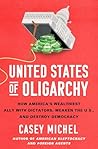
Review: United States of Oligarchy: How America's Wealthiest Ally with Dictators, Weaken the U.S., and Destroy Democracy

United States of Oligarchy: How America's Wealthiest Ally with Dictators, Weaken the U.S., and Destroy Democracy by Casey...