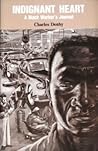
 Indignant heart, a black worker's journal by Charles Denby
My rating: 3 of 5 stars
A South tenement farmer recalls a Zelig-like existence over decades of civil rights for Black Americans. I have to confess his ubiquity at times defies credibility to me and with the layers of misdirecting anonymity in the authorship here, I would like to read a Denby biography with detail and sources. Black autoworker Denby was Marxist-Humanist activist, and the longtime editor of the radical newspaper News & Letters.
He, like many others, migrated to Detroit landing at Arthur Gordon’s boarding house on the city's West Side. While the majority of Great Migration histories focus heavily on the East Side enclaves of Black Bottom and Paradise Valley, a vibrant, property-owning Black community simultaneously developed on the West Side. Gordon was part of this smaller, highly organized network of West Side Black homeowners who offered alternative, less congested housing option for incoming laborers. Denby notes that Arthur Gordon was "light-colored" while his wife was dark-skinned. He refers to the "Blue Vein": Light-skinned African Americans who had established themselves in Northern cities prior to World War I often had greater access to capital, banking loans, or employment, allowing them to purchase property early. While some established Northern Black elites sought to distance themselves from the massive influx of rural Southern migrants, individuals like Arthur Gordon actively commercialized their spaces. By converting his property into a reliable $10-a-week business, he bridged the gap between the established Black middle class and the incoming industrial working class.
In Detroit, Denby comes across laws from progressive legislators such as Diggs and the Reuther camp and more Communist - Marxist factions inside the UAW and other unions which proved a receptive grounds for the axioms of Trotskyism.
Stokely Carmichael (Kwame Ture) was a prominent figures in 20th-century Black liberation and radical labor movements who paths crossed with Denby during the 1960s Civil Rights Movement, particularly around organizing in Lowndes County, Alabama. Carmichael chaired the Student Nonviolent Coordinating Committee (SNCC), co-founded the Lowndes County Freedom Organization, popularized the "Black Power" slogan, and later became a leading Pan-Africanist in Guinea. Denby, who had roots in Lowndes County, Alabama, led an association in Detroit that sent vital financial and material aid (food, money, books, and clothing) to support the local civil rights struggle there. During this period, Denby traveled south and directly interacted with Carmichael, who was working as a SNCC field organizer registering Black voters and building independent political power in the county. While Denby supported the grassroots freedom struggle in Lowndes County, he and Carmichael had ideological differences over the direction of the movement. Denby approached Black liberation through a Marxist-Humanist lens—emphasizing multiracial working-class solidarity and the revolutionary agency of rank-and-file Black workers—whereas Carmichael increasingly moved toward Black nationalism, Black Power, and later Pan-Africanism. Denby chronicled his firsthand encounters with Carmichael and other southern civil rights leaders, offering a rank-and-file worker's perspective on the political shifts of the mid-to-late 1960s.
Denby also recalls George Wallace in a profile that feels very much like the modern populists we have.
Black people know this Wallace. When I heard about Hulett coming out for Wallace, I remembered a rally held for Wallace that I had attended back in 1968 in Cobo Hall in Detroit. I felt it was a must for me to be there to see the action and reaction to him. As soon as I entered the building, I could feel and sense the tension. You felt like you were sitting among a jungle of wild beasts and that if you did not quickly transform yourself into a ferocious beast or escape from this meeting, that you would be caught and destroyed as soon as this man got in the position to do it. You could see these beasts putting fear or trying to put fear into anyone who opposed Wallace. This was the tone of those who spoke before Wallace came to the platform.
Long before Wallace came to the platform, some of his supporters attacked a group of protestors. A huge Wallace supporter hit a small woman in the face with all the force he could, while another Wallace supporter cheered him on. When the police finally came, you could see they were on the side of the Wallace supporters. When Wallace finally came out to speak, reports said he received a seven minute ovation before he could get started. The truth is that that boos were so loud and long that his supporters were yelling to try to drown out the boos.
Wallace said the same things he had been saying from the beginning of his campaign. I wondered what was making these people who were supporting him tick. Then I felt, "This is fascism." These were the people who were yelling with happiness when the dogs were tearing the insides out of the Black people in Birmingham in 1963, under the direction of George Wallace. They were screaming and yelling when Wallace police and state troopers on horses, with swinging clubs in their hands, had the blood of civil rights workers running in the streets of Selma.
This is his account, also published in the November 1968 issue of News & Letters, describing Wallace's presidential campaign rally at Cobo Hall in Detroit on October 29, 1968. Third-party candidate Wallace spoke before roughly 11,000 supporters while around 1,000 protesters gathered outside and inside. According to archival accounts in Detroit Under Fire, the campaign sought televised clashes with hecklers to rally supporters. Brawls broke out inside Cobo Hall, police intervened amid disputes over crowd control, and clashes continued outside after the speech ended. Wallace ran on a populist, segregationist, and "law and order" platform as the American Independent Party nominee during the 1968 election, drawing strong opposition from civil rights activists and student demonstrators who linked him to racial violence in Birmingham (1963) and Selma (1965).
Workers Battle Automation is a 1960 article and labor pamphlet written by Denby. It collects firsthand accounts from production workers on how industrial automation affected jobs, pace of work, and working conditions. You can view the August–September 1960 special issue PDF on Marxists Internet Archive or access the digital pamphlet through News and Letters. It collects firsthand accounts from production workers on how industrial automation affected jobs, pace of work, and working conditions.
View all my reviews



No comments:
Post a Comment