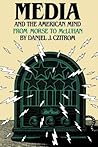
 Media and the American Mind: From Morse to McLuhan by Daniel Czitrom
My rating: 4 of 5 stars
Telegraph transportation
Movies represented "the most spectacular single feature of the amusement situation in recent years," a situation that included penny arcades, dance academies and dance halls, vaudeville and burlesque theaters, pool rooms, amusement parks, and even saloons. Motion pictures inhabited the physical and psychic space of the urban street life. Standing opposite these commercial amusements, in the minds of the cultural traditionalists, were municipal parks, playgrounds, libraries, museums, school recreation centers, YMCAs, and church-sponsored recreation. The competition between the two sides, noted sociologist Edward A. Ross, was nothing less than a battle between "warring sides of human nature-appetite and will, impulse and reason, inclination and ideal." The mushrooming growth of movies and other commercial amusements thus signaled a weakness and per-haps a fundamental shift in the values of American civilization.
"Why has the love of spontaneous play," wondered Reverend Richard H. Edwards, "given way so largely to the love of merely being amused?"
For those who spoke about "the moral significance of play" and preferred the literal meaning of the term recreation, the flood of commercial amusements posed a grave cultural threat. Most identified the amusement situation as inseparable from the expansion of the city and factory labor. Referring to the enormous vogue of the movies in Providence, Rhode Island before World War I, Francis R. North noted the "great alluring power in an amusement ..."
Propaganda analysis emerged as a significant new activity after the armistice. During the Great War propaganda had become a massive scientific endeavor, a sophisticated art critical to the military efforts of all the combatants. Utilizing the latest forms of modern communication, nations made propaganda a regular feature of governing-a tendency that continued after the war's end. Propaganda acquired a sinister connotation; it meant partisan appeal based on half-truths and devious manipulation of communications channels. A postwar wave of autobiographies, exposés, and popular articles helped further a belief in the deceitful power of propaganda and the ease with which modern media could be insidiously controlled in its service. The scholarly studies of propaganda generally took these fears as their starting point.
For example, Harold Lasswell's pioneer work, Propaganda Technique in the World War (1927), began by noting: "We live among more people than ever who are puzzled, uneasy, or vexed at the un-known cunning which seems to have duped and degraded them. It is often an object of vituperation, and therefore, of interest, discussion, and, finally, of study." Lasswell sought to classify the mechanisms, tactics, and strategies of propaganda, which he defined as "the control of opinion by significant symbols... by stories, rumors, reports, pictures, and other forms of social communication." Other propaganda studies in these years also directed attention to how the modern media operated and how they could be abused for propaganda purposes in various countries, particularly during wartime.
Innis
In McLuhan's view, southern culture stood as a modern manifestation of the Cinesniam deal of rational man reaching his noblest attainment in the expression of an eloquent wisdom." According to McLuhan, ever since Socrates used dialectics against the rhetoric of his sophist teachers, a continuing quarrel had raged over whether grammar and rhetoric on the one hand or dialectics on the other should prevail in organizing knowledge. The debate continued among medieval and Renaissance authorities, with the Schoolmen Insisting that one part of the trivium be the superior method in the-ology (dialectics) and the humanists insisting on the others (gram-mar, rhetoric). As the quarrel heightened in seventeenth-century England, representatives of both parties migrated to America the Schoolmen to New England and the quasi-humanist gentry to Virginia.
In America, McLuhan argued, the two radically opposed intellectual traditions developed on new soil and were geographically separated for the first time. Nourished by the agrarian estate life of the South, the Ciceronian ideal reached its flower in "the scholar states-man of encyclopedic knowledge, profound practical experience, and voluble social and public eloquence." It produced, among other things, the most creative tradition in American political thought, a tradition that stretched from Jefferson to Wilson. It advocated an agrarian society with every man as aristocrat and subordinated knowledge and action to a political good. On the other hand, the New England mind afforded a sharp contrast. Based on the Ramist application of dialectics to theological controversy, it embodied a thoroughly different tradition: "For this mind there is nothing which cannot be settled by method. It is the mind which weaves the intricacies of efficient production, 'scientific' scholarship, and business administration. It doesn't permit itself an inkling of what constitutes a social or political problem... simply because there is no method for tackling such problems." McLuhan thus reduced Ameri-can history to an internal debate within the medieval trivium. Southern literature's stress on passion versus the northern concern with character, the Civil War, and the educational debate at Chicago over the "Great Books" program all reflected the intellectual struggle of the humanist against the technological specialist. McLuhan left no doubt where his own sympathies lay. His affinity with the southern Agrarian movement of the 1920s and 1930s is striking. McLuhan, the Catholic and provincial Canadian, joined John Crowe Ransom in celebrating the South as the true inheritor of the humanist tradition...
View all my reviews


No comments:
Post a Comment